Applied Artificial Intelligence Innovation Challenge 2026
AIIC2026 Hackathon Competition Objectives
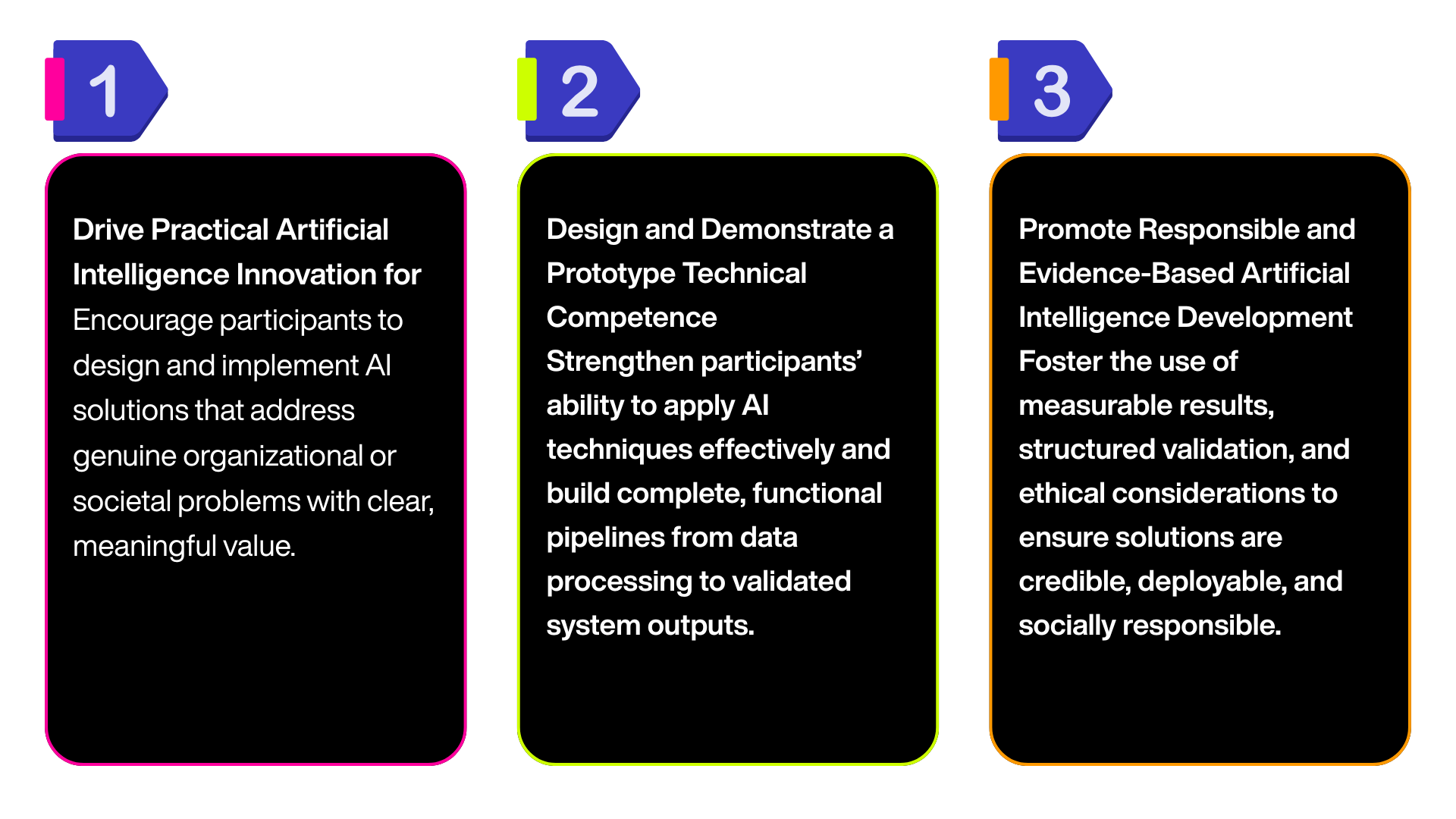
AIIC 2026 encourages students to progress beyond AI as theory and develop practical, implementable solutions that modern organizations and enterprises can adopt, evaluate, and scale.
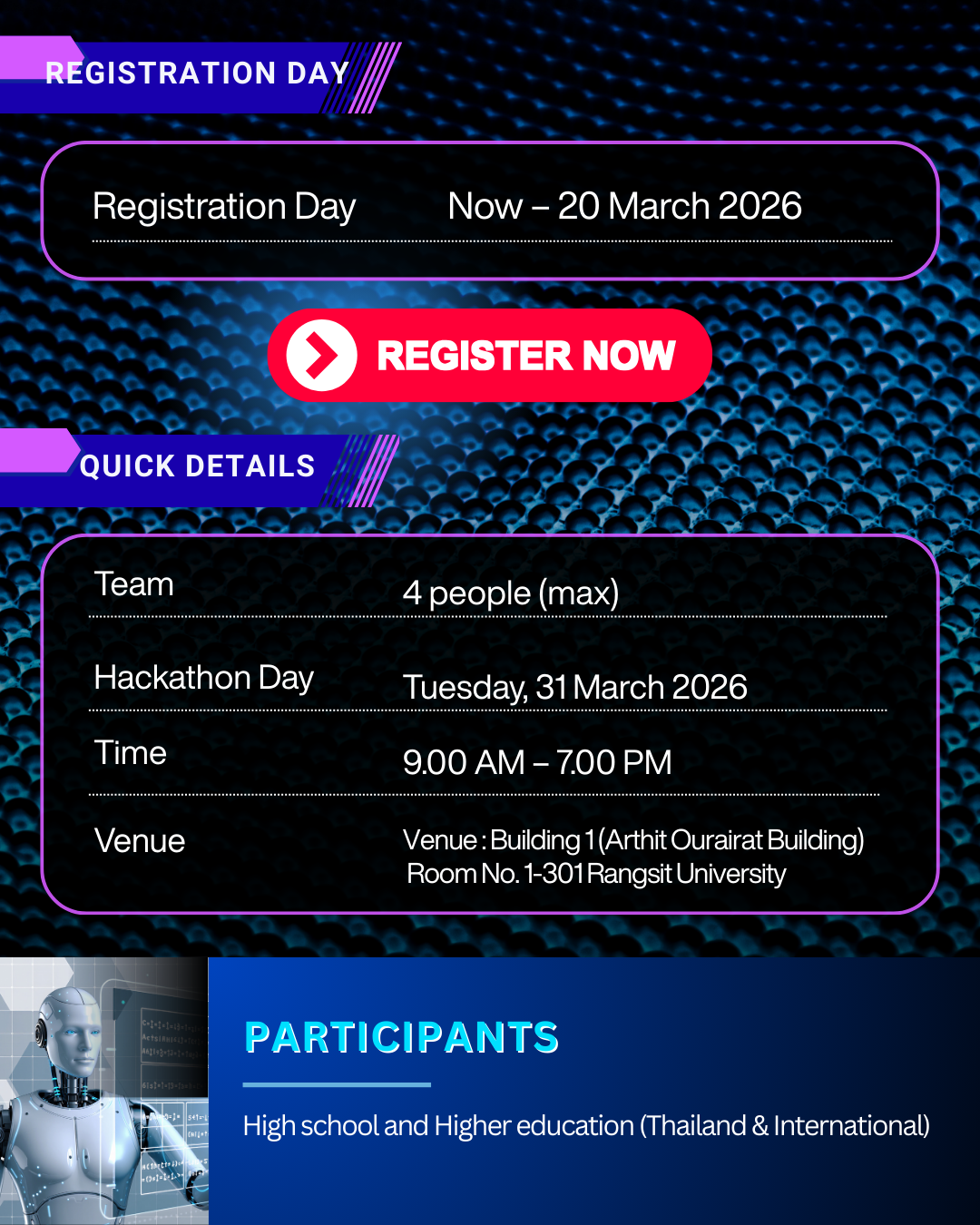
About the Challenge
The challenge provides a structured opportunity for students to work with real organizational and business problem contexts, select an appropriate technical approach, and deliver a functional project with measurable outcomes.
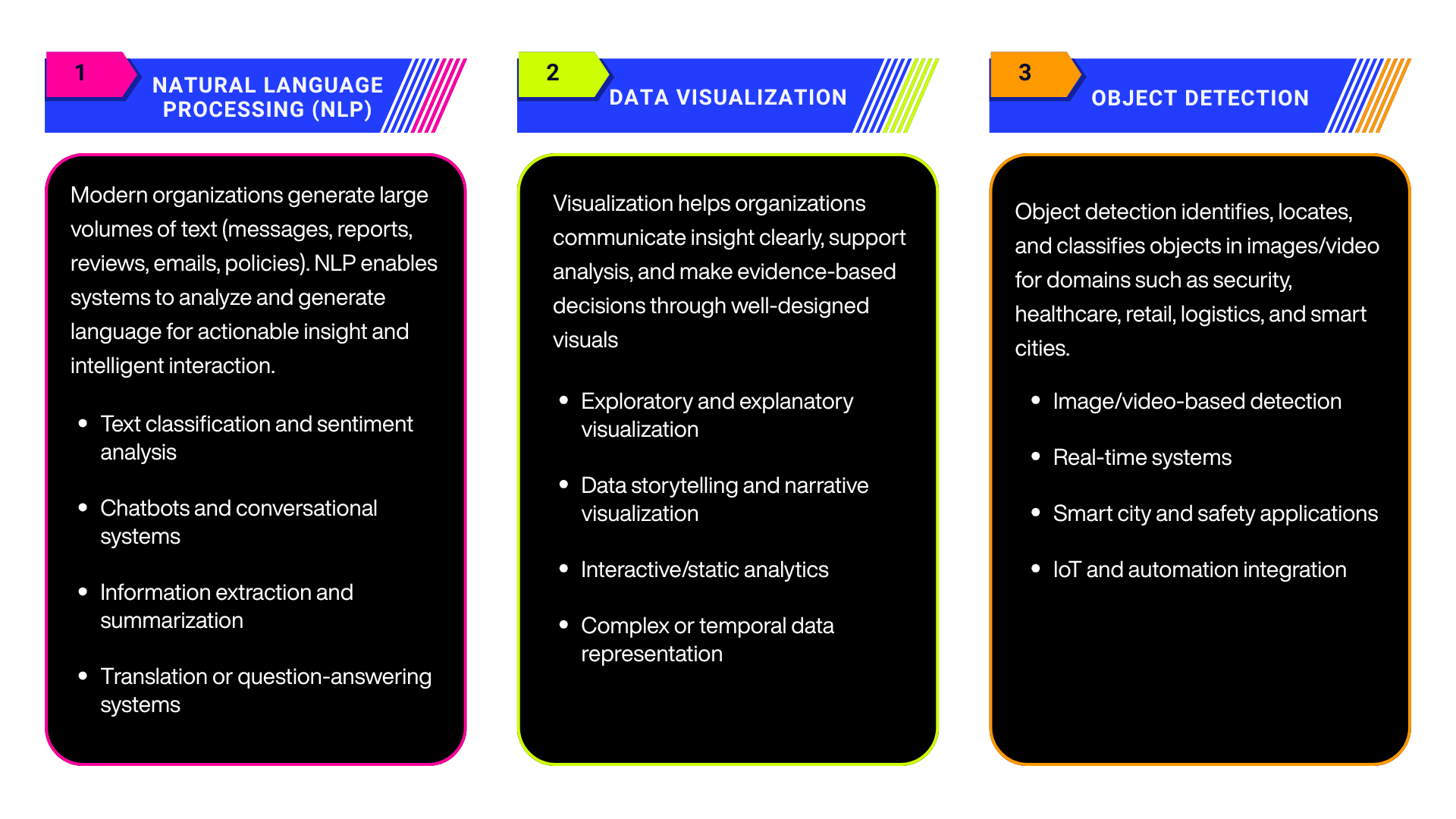
Core Track
Teams may focus on one track or integrate multiple tracks where it strengthens real-world applicability.
About the Challenge
End-to-end functional prototype
Demonstrate a complete workflow from data to AI processing to user-facing output.
Measurable results
Evidence-based metrics including model performance or operational improvements.
Organizational value
Clear benefits to enterprises such as efficiency, automation, decision support, or safety.
Responsible AI readiness
Considerations of privacy, ethics, transparency, and deployment feasibility.
Assessment Criteria
The evaluation is conducted in two rounds: a walkaround prototype assessment (Top 10 selection) and a final presentation with prototype validation (Top 3 winners).
Round 1: Walkaround Prototype Evaluation (Select Top 10)
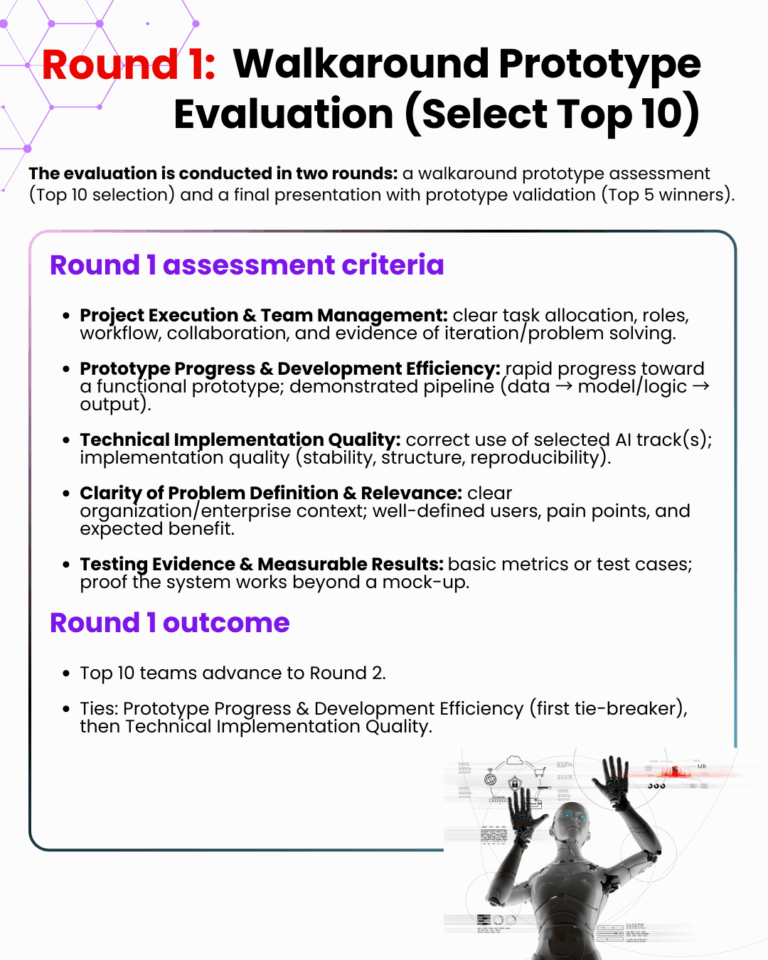
The evaluation is conducted in two rounds: a walkaround prototype assessment (Top 10 selection) and a final presentation with prototype validation (Top 5 winners).
Round 1 assessment criteria
- Project Execution & Team Management: clear task allocation, roles, workflow, collaboration, and evidence of iteration/problem solving.
- Prototype Progress & Development Efficiency: rapid progress toward a functional prototype; demonstrated pipeline (data → model/logic → output).
- Technical Implementation Quality: correct use of selected AI track(s); implementation quality (stability, structure, reproducibility).
- Clarity of Problem Definition & Relevance: clear organization/enterprise context; well-defined users, pain points, and expected benefit.
- Testing Evidence & Measurable Results: basic metrics or test cases; proof the system works beyond a mock-up.
Round 1 outcome
- Top 10 teams advance to Round 2.
- Ties: Prototype Progress & Development Efficiency (first tie-breaker), then Technical Implementation Quality.
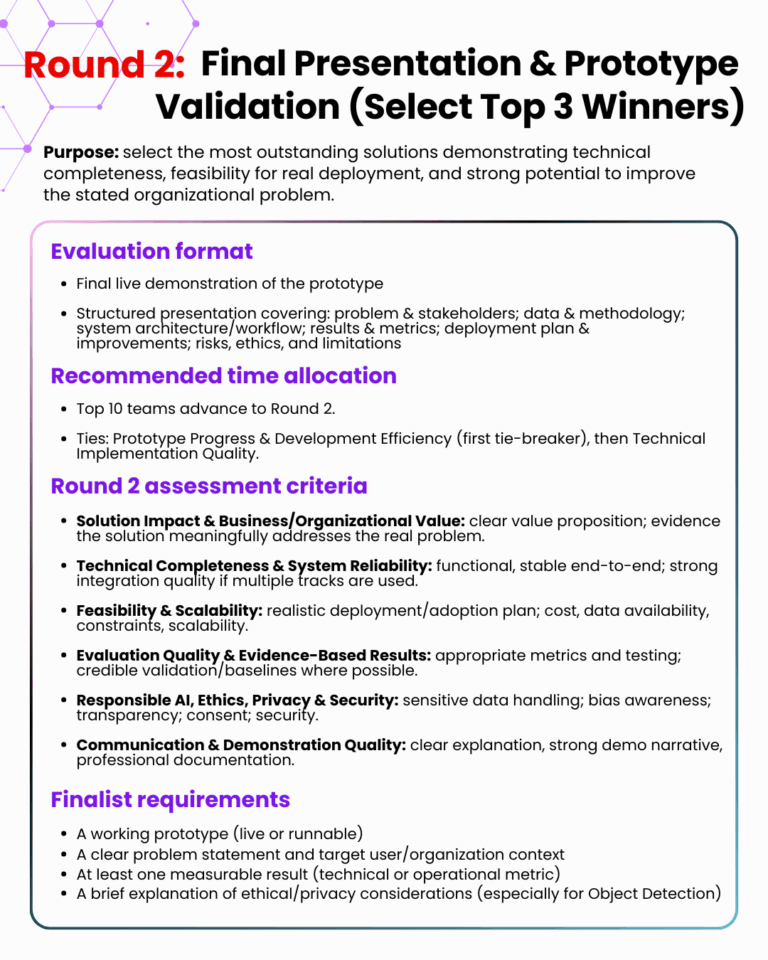
Round 2: Final Presentation & Prototype Validation (Select Top 3 Winners)
Purpose: select the most outstanding solutions demonstrating technical completeness, feasibility for real deployment, and strong potential to improve the stated organizational problem.
- Final live demonstration of the prototype
- Structured presentation covering: problem & stakeholders; data & methodology; system architecture/workflow; results & metrics; deployment plan & improvements; risks, ethics, and limitations
Recommended time allocation
- 10 minutes presentation + demo
- 5 minutes Q&A
Round 2 assessment criteria
- Solution Impact & Business/Organizational Value: clear value proposition; evidence the solution meaningfully addresses the real problem.
- Technical Completeness & System Reliability: functional, stable end-to-end; strong integration quality if multiple tracks are used.
- Feasibility & Scalability: realistic deployment/adoption plan; cost, data availability, constraints, scalability.
- Evaluation Quality & Evidence-Based Results: appropriate metrics and testing; credible validation/baselines where possible.
- Responsible AI, Ethics, Privacy & Security: sensitive data handling; bias awareness; transparency; consent; security.
- Communication & Demonstration Quality: clear explanation, strong demo narrative, professional documentation.
Finalist requirements
- A working prototype (live or runnable)
- A clear problem statement and target user/organization context
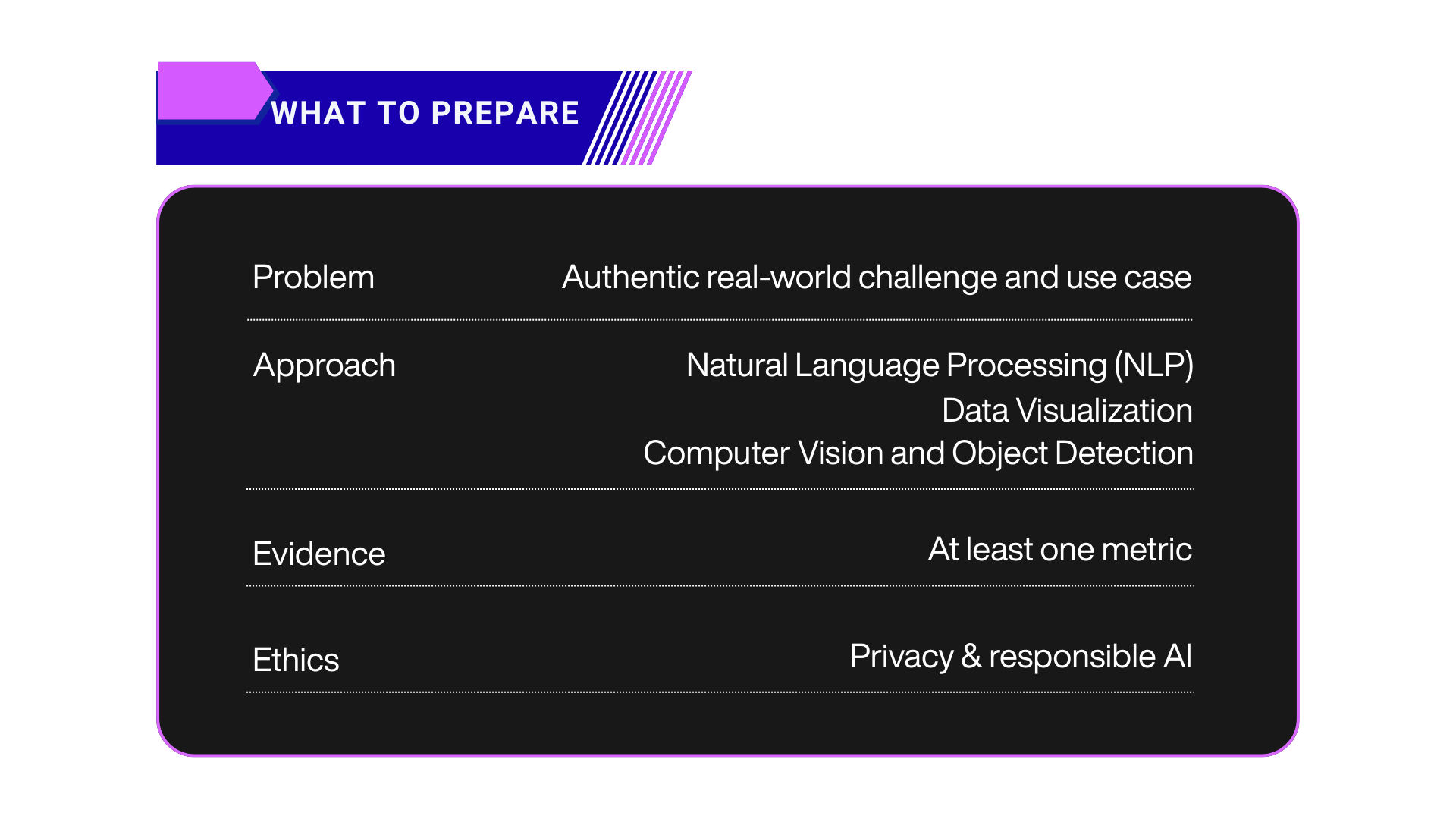
- At least one measurable result (technical or operational metric)
- A brief explanation of ethical/privacy considerations (especially for Object Detection)
Assessment Criteria
Competition Awards Competition Awards for All Categories

Competition Schedule & Guidelines
Please read and carefully follow the competition schedule and requirements:
Submission of Video Demo and Prototype
Start on February 1, 2025
- Each team must submit a video demonstration and a working prototype of their project.
- No additional tasks are required during this period; submissions will be reviewed in the next stage.
last date March 10, 2025
__________________________
Announcement of 20 Finalist Teams
21 March 2025
- The top 20 teams selected from the first round will be announced and will proceed to the final round.
__________________________
Grand Finale & Award Ceremony
27 March 2025
- Time: 09:00 - 16:30 (UTC+7, Bangkok Time).
- Venue: Building 6 (Student Center), Room 6-200, Rangsit University.
- All finalist teams must present their application and conduct a live demonstration of their system/app (not a prototype) in front of the judges and audience.
- The final winners will be announced at the end of the event.
__________________________
Important Notes
- From 1 February to 5 March 2025, participants are only required to submit a video demo and prototype.
- On 27 March 2025 (Final Round), all participants must give a live demo and present their project in person.
__________________________
Video Demo and Prototype Submission
Prepare and submit your comprehensive demo video showcasing your project’s functionality along with the prototype.
Please take note that you will need to login and use your Google account to submit the files in the submission form.
- Ensure the video effectively addresses all key tasks related to Main Area 1 and Main Area2.
- The video must clearly demonstrate how the system handles these core areas, including essential features, workflows, and user interactions.
- Submit the video along with your prototype within the specified deadline.
If you’re unsure about the key tasks related to Main Area 1 and Main Area 2, please refer to the booklet provided for detailed guidance. The booklet contains all the necessary information to ensure that your demo video addresses each of the required tasks for these areas.
Be sure to carefully review the booklet to cover all essential tasks before submitting your video and prototype.
Requirements of Each Team
Each Team Consists of A Maximum of FOUR (4) Members.
Each Team Hust Have At Least ONE (1) Supervisor and Can Have A
Maximum of TWO (2) Supervisors.
KEY TASKS AND REQUIREMENTS
Track 1: Create Visual Data Presentations
- Generate Booking Report and Analytics
- Develop DCP & CRM
- Utilize the Transaction Console for Profit/Loss Reports
- Utilize the Transaction Console preset for Daily Report
- Analyze inventory performance dashboard
Track 2: Develop Programs to Enhance Service Operations
- Redesigning Existing Websites
- Online Golf Booking Platform
- Online Membership Platform
- Creating of Guest Self Check-In